Beyond the comfortzone
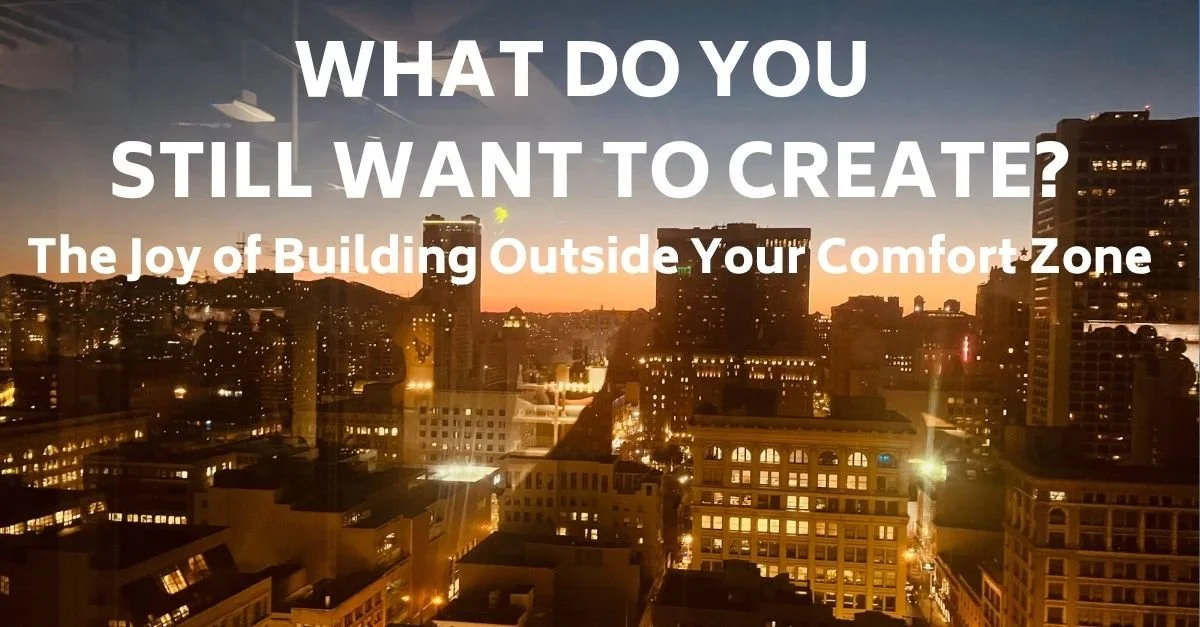
Maybe the future — and much of the fun — begins outside our comfort zone.
A few weeks ago in Silicon Valley, I met a man in his mid-fifties who had spent more than twenty-five years working in different technology companies. At 52, he decided to leave and start his own AI company.
What fascinated me was not so much the company or even the technology. It was the way he talked about it.
There was this almost childlike joy in building something new, in solving a real-world problem, in trying something without knowing exactly where it would lead. He did not talk about the next stage of his career. He talked about what he still wanted to create.
I know this feeling very well. There is something deeply satisfying — and, yes, simply fun — about creating something that did not exist before. It made me think about conversations I have back home in Austria.
When I talk to friends and acquaintances around the same age, I often hear a very different question:
“When do you retire?” There is absolutely nothing wrong with thinking about slowing down. But the contrast fascinates me.
Same stage of life, similar experience — and sometimes a completely different relationship with what comes next.
But there is something I experience again and again in the Valley: a fascination with what does not exist yet.
In Europe, many of our strengths come from what we have already built. Great industrial companies, engineering excellence, quality, reliability, generations of accumulated knowledge. We are very good at protecting these strengths.
The question I increasingly ask myself is whether this strength can sometimes also become our comfort zone. Because the real excitement of creating something new rarely happens inside it.
What AI is really challenging
I spent time with venture capitalists, AI and robotics founders, engineers and CEOs in the valley, discussing everything from computer vision and autonomous systems to engineering, supply chains and new business models.
Of course, much of the conversation was about technology. What has become possible? What is now good enough to use? What will become possible over the next few years? And the speed is extraordinary.
But what if the technology is ready — and the organization isn't?
And what if the organization is ready — but the people leading it aren't?
Example: I saw the same thing from a completely different angle in work with a European machine building manufacturer. The interesting question was eventually not how AI could make the existing machine a little better. It was whether technology could enable an entirely different business model: instead of selling machines, sell outcome based on actual usage.
Suddenly, AI is no longer an IT project. It touches the business model, processes, responsibilities and ultimately the identity of the company.
What should we actually optimize?
Efficiency? Resilience? Growth? Identity? Community? Speed? Long-term survival?
The better our machines become at optimizing, the more precisely we as humans may need to know what should — and should not — be optimized. For me, this is where the conversation about AI starts becoming a conversation about leadership. I wrote a book about mature leadership several years ago. At the time, AI was not at the center of my thinking. But today I find myself returning to many of the same questions from a completely new perspective.
What happens when a leader stands in a room and realizes that a machine can do something they used to be paid — and respected — for knowing how to do?
What happens when AI knows more about a particular question than I do?
When a younger colleague understands a technology I barely understand?
For decades, our image of leadership has been closely connected to knowing, deciding, approving and controlling. AI challenges this. Most experienced leaders understand perfectly well that they need to delegate, experiment and allow other people — and increasingly machines — to know more than they do.
The interesting question is what happens inside us when that moment actually arrives.
Can I say “I don't know” without experiencing it as weakness?
Can I remain present when there is no clear answer?
Can I give other people orientation without pretending to have certainty myself?
The bigger question for Europe
I have enormous respect for family-owned companies that have built their businesses in the same regions for generations. But we should not take for granted that this will still be possible ten or twenty years from now. A company can choose to stay rooted in its home region — but only as long as it remains competitive enough to afford that choice.
And that choice is becoming harder. Chinese companies are becoming faster, more innovative and increasingly formidable competitors in many of the industries in which Europe has traditionally been strong.
What gives me hope is this: the same technology that creates this pressure also lowers the barriers to build something new. Starting a company has never been more accessible.
And I believe we need more of that builder energy in Europe — including from the next generation of family business owners. Passing on a company is one gift.
Passing on the courage to build something that doesn't exist yet might be an even greater one.
At the same time, technology will continue to get smarter — probably much faster than most of us expect. The real question is whether our companies, our leaders and ultimately Europe itself are willing to grow with it. And maybe that is where the real adventure begins.
Because the future rarely waits inside our comfort zone. And, in my experience, neither does the fun. The most interesting people I've met — in Silicon Valley and everywhere else — were not the ones who had it figured out. They were the ones who stepped outside anyway.
Go let us build something, the future is not wating.
P.S. These are exactly the kinds of conversations we explore with CEOs and business owners during our Silicon Valley Learning Journeys. More about the next journey here:
Autor: Werner Sattlegger, Foudner Art of Life

Autor: Werner Sattlegger
Founder & CEO Art of Life
Experte für digitale Entwicklungsprozesse, wo er europäische mittelständische Familien- und Industrie-unternehmen von der Komfort- in die Lernzone bringt. Leidenschaftlich gerne verbindet er Menschen und Unternehmen, liebt die Unsicherheit und das Unbekannte, vor allem bewegt ihn die Lust am Gestalten und an Entwicklung.