Per Aspera
Per Aspera: Nothing Is Built in Comfort
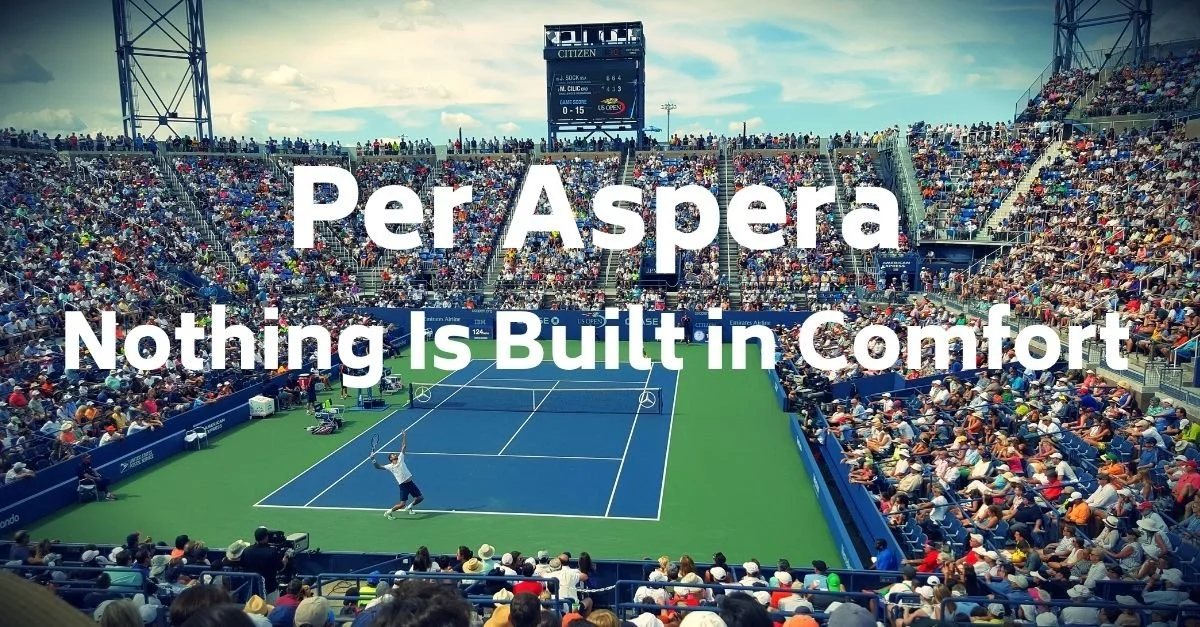
A few days ago I watched a documentary about Novak Djokovic with my son. I was curious to get to know this titan, who has won 24 Grand Slams, cry like a child after a tough loss at the US Open.
And there was this little tiny word: inat. A Serbian word with no direct translation. The closest you get is stubborn defiance mixed with wit and a "watch me" attitude — to get better under pressure, and to show everyone else that they were wrong. Djokovic was always better when he was under pressure — that's when he put his best tennis on the table. Novak Djokovic once said that part of his resilience comes from exactly that — shaped by a childhood during the NATO bombing of Belgrade, when failure simply wasn't an option for his family.
You don't get weaker under pressure. You get stronger. Not despite the threat. Because of it.
That's not a romantic claim anymore. I don't like crises either, but they make me stronger. Over a decade ago, Nassim Taleb coined the term that finally captures the concept with precision: antifragility.
The distinction from resilience is crucial, even though business jargon likes to use the two words interchangeably. Resilient means: a system survives a shock and returns to baseline.
Antifragile means: a system becomes better because of the shock. A rock is resilient. A muscle is antifragile.
Most organizations, most people, build for resilience. They want to survive the shock, not benefit from it. That's understandable. It's also why they look strong in calm periods and still collapse when a real crisis hits.
What the research says
Here's the mechanism, stripped down.
Two psychologists, Jim Blascovich and Joe Tomaka, put people through real pressure — a speech, a hard test, something with real stakes — while monitoring their hearts. In every single case, the heart sped up. That part never changed. Pressure always makes your heart race, no exceptions.
What changed was the blood vessels.
In some people, the vessels widened. More blood could flow, faster, to the muscles and brain — exactly where it's needed to perform.
In other people, the vessels narrowed instead. The heart was racing just as hard, but now pushing blood through a smaller opening — like a hose with a thumb over the end. More pressure, less flow. That's the physical feeling of choking under stress: heart pounding, but everything feels stuck.
The difference between the two groups wasn't the situation. It was one sentence, silently running through their heads beforehand. The widened-vessel group had told themselves: I can handle this. The narrowed-vessel group had told themselves: this is too much for me.
Same test. Same heart rate. Opposite plumbing — because of a single belief.
Researchers named these two states challenge (vessels open) and threat (vessels narrow). And it isn't just a lab curiosity: a 2025 analysis pulling together 62 separate studies and more than 7,400 people found the same pattern again and again — people in the challenge state consistently perform better than people in the threat state, across exams, sport, public speaking. In one experiment, golfers were simply told, right before a putt, to see the shot as a challenge instead of a threat. Nothing else changed. Same green, same hole, same distance. The challenge-framed golfers sank more putts.
The pressure never moved. Only the sentence in their heads did.
The rudest advice of the year
Nvidia founder Jensen Huang put it bluntly enough to unsettle a lot of people, telling Stanford graduates that he didn't know how to teach resilience — except by wishing them ample doses of pain and suffering. Greatness, he said, doesn't come from intelligence. It comes from character. And character isn't built by smart people. It's built by people who suffered. And that in front of rich kids studiying in Stanford in order to get the best education.
A strange thing to hear from a billionaire whose company just became the most valuable in the world. But Huang himself grew up under conditions he describes as full of setbacks and hardship. He isn't talking theory.
What this means for your company
The uncomfortable transfer: a team that never faces real pressure doesn't become more robust and better. It becomes more fragile, soft and stays in the comfortzone, where it is cosy and warm.
So what happens is that the team slowly loses the ability to tell the difference between a problem we solve and a problem that overwhelms us. Every small change, every new AI tool or every new market turns into complaining or a crisis, because the team never learned what a real crisis feels like — or that you can get through one.
Per aspera ad astra, the Romans already said. Through hardship to the stars. Not a new thought. Just one every generation forgets and has to relearn.
What we can do
You can't manufacture hardship without it becoming cynical. But you can stop engineering it away the moment it arises on its own. You can stop managing every uncertainty out of existence before anyone on the team has a chance to learn they can withstand it.
And it all starts with how we raise our children — and I know what I'm talking about. I love my son, and I want the best possible environment for him. Which means I have to force myself not to become a curling dad. Curling parents sweep every obstacle out of the child's path before it even becomes friction. It comes from love, not neglect. But a child who never has to push against anything never learns what pushing feels like.
The corporate version looks almost identical: Shield the team from every setback, absorb every difficult client call yourself, rewrite every mediocre draft instead of sending it back.
It feels like good leadership. It's actually the same sweep. A few things work better: let a team member sit with a hard problem for a day before stepping in. Let them deliver bad news to a client themselves, with your backing but not your voice. Debrief failures out loud, in the open, instead of quietly fixing them before anyone notices. None of it requires manufacturing crisis. It just requires resisting the urge to clear the ice.
No one toughens up in the shade. You get strong because it was cold once — and you kept moving anyway.
— Werner
P.S. The west coast in the Silicon Valley Learning is a palce where we can learn this - the next journey here:
Autor: Werner Sattlegger, Foudner Art of Life
Literature
Blascovich, J., & Tomaka, J. (1996). The biopsychosocial model of arousal regulation. Advances in Experimental Social Psychology, 28, 1–51. Foundational paper establishing the Biopsychosocial Model of Challenge and Threat — the distinction between appraising a demanding situation as a challenge (resources meet or exceed demands) versus a threat (demands exceed resources), and the divergent cardiovascular patterns each produces.
Hase, A., Nietschke, M., Kloskowski, M., Szymanski, K., Moore, L., Jamieson, J. P., & Behnke, M. (2025). The effects of challenge and threat states on performance outcomes: An updated review and meta-analysis of recent findings. EXCLI Journal. Meta-analysis of 62 studies (N = 7,418) confirming that challenge-state appraisal facilitates performance relative to threat-state appraisal, across sport, education, and other high-pressure domains.
Moore, L. J., Vine, S. J., Wilson, M. R., & Freeman, P. (2012). The effect of challenge and threat states on performance: An examination of potential mechanisms. Psychophysiology. Controlled study (N = 127) showing that golfers instructed to appraise a putting task as a challenge performed more accurately, with more effective gaze behavior and muscle activity, than those instructed to appraise it as a threat.
Taleb, N. N. (2012). Antifragile: Things That Gain from Disorder. Random House. Introduces the concept of antifragility — systems that improve, rather than merely survive, when exposed to stressors, volatility, and disorder.
Links
Blascovich & Tomaka (1996): https://doi.org/10.1016/S0065-2601(08)60235-X
Taleb, Antifragile (2012), publisher page: https://www.penguinrandomhouse.com/books/176227/antifragile-by-nassim-nicholas-taleb/

Autor: Werner Sattlegger
Founder & CEO Art of Life
Experte für digitale Entwicklungsprozesse, wo er europäische mittelständische Familien- und Industrie-unternehmen von der Komfort- in die Lernzone bringt. Leidenschaftlich gerne verbindet er Menschen und Unternehmen, liebt die Unsicherheit und das Unbekannte, vor allem bewegt ihn die Lust am Gestalten und an Entwicklung.