The Art of Change
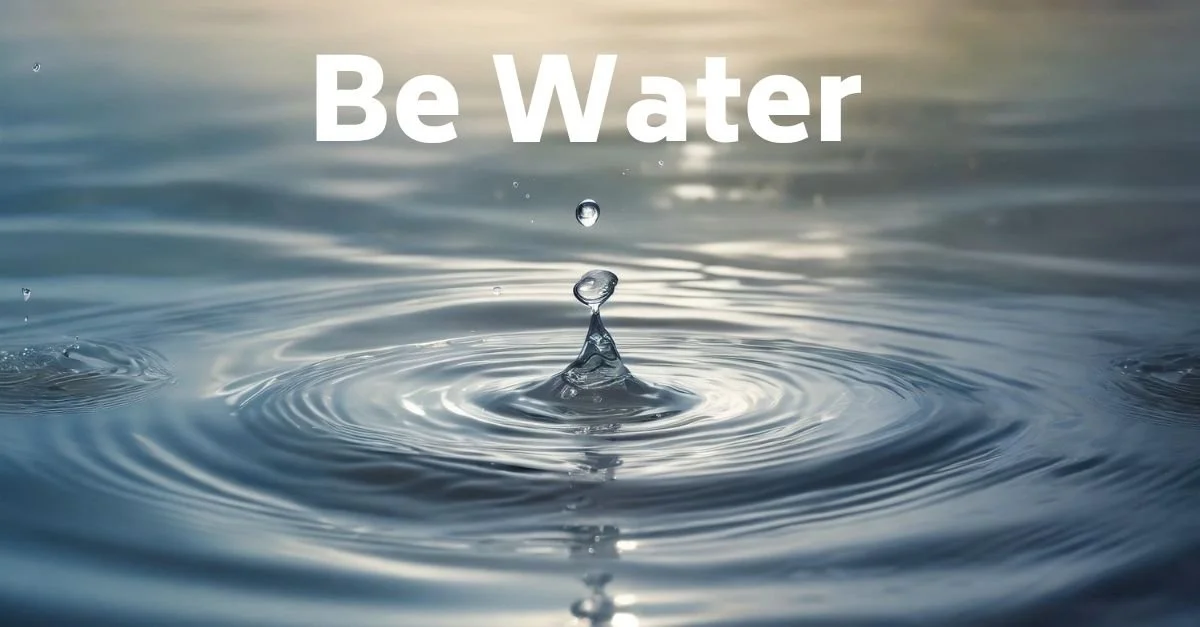
"Be water, my friend."
Bruce Lee said it in 1971, in a television appearance. He was describing his philosophy of combat: don't resist rigidly, flow. Take the shape of the situation. Yield where force is pointless. Strike when the moment demands it. Water has no fixed form. It takes the shape of whatever contains it — without losing what it is.
It took me a long time to understand that this isn't a metaphor about martial arts. It's a thesis about organizations.
"Empty your mind. Be formless, shapeless, like water. You put water into a cup — it becomes the cup. You put water into a bottle — it becomes the bottle. You put it into a teapot — it becomes the teapot. Now water can flow, or it can crash. Be water, my friend."
— Bruce Lee, 1971
The Oldest Book About Change
The philosophy behind Bruce Lee's image of water has ancient roots. In the Tao Te Ching, Lao Tzu described water as the archetype of wisdom: soft, formless, unassuming — and yet capable of wearing through the hardest stone. Bruce Lee drew on that idea from Taoism, distilled it, and translated it into a language that a modern, Western audience could feel. e made it live.
But there's an even older text that has been on my mind in connection with all this: the I Ching — the Book of Changes. Written in China nearly three thousand years ago, its central idea is radically simple:
Change is not the interruption of a stable state. Change is the state itself.
The world, according to the I Ching, is not a system that occasionally shifts before settling back into equilibrium. It is in permanent motion. The book's 64 hexagrams don't describe fixed situations — they describe stages of change. Every condition already carries the seed of the next one within it.
The Transformation Project and Its Problem
Most companies I encounter treat AI like a project. There's a kickoff meeting. A budget. A go-live date. And somewhere down the road — this is the quiet hope — the transformation will be complete. Stability will return. Everyone will know how things work again.
I understand that impulse. Industrial companies have been optimized over decades for reliability, repeatability, precision. That's not a weakness. It's a profound strength. The people who build machines that need to run flawlessly for twenty years think very differently from the people who ship an app in three months — and they should.
But the transformation project has a problem.
AI models keep improving. Agents become more capable. Physical AI is moving into factory floors, logistics, quality control. What's innovative today is a baseline in eighteen months — and potentially obsolete in three years.
There is no finish line to wait for. Which means: the answer to AI cannot be a one-time transformation. It has to be a durable capability. The capacity to keep changing — not once, but continuously.
Not a project. A capability.
What I See in Silicon Valley
I've spent extended periods in Silicon Valley every year for many years, bringing European owners and executives there to see it firsthand. After all this time, what still impresses me most is not the technology.
It's the willingness to abandon assumptions.
I've met founders who completely rebuilt their product after six months because they recognized their original thesis was wrong.
I've watched teams restructure themselves because the work demanded it — not because an org chart allowed it.
I've seen decisions made with thirty percent of the information anyone would normally consider necessary, because waiting for more certainty would have cost more than the risk itself.
That can sound chaotic. Sometimes it is. But it's not chaos from carelessness. It's a deliberate choice — speed over perfection, adaptability over stability.
Europe tends to think differently. When uncertainty appears, the instinct is often to plan more, align more, approve more. That's not wrong. Rigor, care, reliability — these aren't flaws, they're competitive advantages. No software company has the manufacturing depth of a mid-sized European machine builder.
The question I keep coming back to isn't who's right.
It's this: how do we combine Europe's industrial substance with the adaptive speed this moment demands?
AI Doesn't Just Change Processes
This is where it gets concrete.
When AI accelerates engineering work by a significant multiple, it doesn't just change what engineers do. It changes how long an approval process is allowed to take. A project plan that used to take a month and now takes a week needs a different authorization logic — or the advantage disappears into a queue.
When AI agents take over reporting and coordination, the honest question becomes: what does middle management do then? Not as an accusation — but as a genuine reckoning with roles that need to be redefined.
When computer vision handles quality control in real time, the question of who decides what — and how fast — fundamentally shifts. The system identifies the defect in seconds. But who decides what happens next, and on what timeline?
When robotics becomes available as a service rather than a capital asset, capacity planning changes entirely. Not: what do we buy and depreciate over ten years? But: what do we need today, next month, for this order volume?
AI changes processes. But in doing so, it also changes the optimal shape of the organization behind them. A hierarchy designed for a certain speed of information doesn't fit a world where information moves much faster. This isn't an AI question. It's a leadership question.
The Paradox of Water
Here is the idea that has taken me longest to work out.
"Be water" does not mean chasing every trend. Water changes its form — but it never loses its substance. Whether it's in a glass, a river, or an ocean, it remains water. Formless, but not substanceless. Adaptable, but not arbitrary.
What would the substance of a company be?
I think it's the promise to customers. The engineering expertise built over decades. The quality people rely on. The values by which decisions get made. These things cannot flow. These things must stay.
What can flow — what must flow — are the forms through which that substance expresses itself. The structures. The processes. The roles. The technologies. The decision-making pathways. The business models.
A manufacturer with thirty years of excellent quality control doesn't need to stop doing excellent quality control. But it must be willing to change the form that control takes — from manual inspection to computer vision, from periodic sampling to real-time monitoring.
The substance stays. The form changes.
That sounds simpler than it is. Because forms become habit. Because structure creates a sense of safety. Because "this is how we've always done it" often doesn't express stubbornness — it expresses the accumulated wisdom of decades.
Which is exactly why the distinction matters so much. What is genuinely substance — and what is merely the form we've mistaken for it?
Adaptability as a Leadership Task
The I Ching doesn't describe a technique for surviving change. It describes an orientation toward it.
The orientation is this: change is not the enemy. It is the condition. The question is not how to stop it — but how to move within it.
For organizations, I translate that this way: stop asking when the transformation will be finished. Start asking how adaptable we've actually become.
That's a different measure. And it demands different decisions.
It requires that decision rights be made explicit — not left to grow historically, but designed consciously. Because when AI accelerates processes, approvals have to accelerate too. Otherwise the water flows — and hits a wall of outdated sign-off procedures.
It requires leaders to be willing to redefine roles — including their own. Not because hierarchy is wrong, but because the hierarchy we have was designed for a different speed of information.
It requires owners to know the difference between what makes their company what it is — and the particular form in which it has expressed itself so far.
This is harder than running an AI project. It touches identity. It touches power. It raises the question of how you recognize a company when so much of it is changing. But I believe it's the more important work.
One Last Question
Bruce Lee wasn't giving advice to software companies. But he described something that holds for any organization that wants to survive in a world that keeps shifting.
The ability to take on a new form — without losing what you fundamentally are.
I'll leave you with two questions.
What is the substance of your company — the thing that cannot change under any circumstances?
And which forms — which structures, processes, decision pathways, role definitions — have you been treating as substance, when they're not?
That distinction, I think, is the difference between companies that genuinely use AI — and those that merely install it.
Werner Sattlegger has been bringing European owners and executives to Silicon Valley since 2018. He is the founder of Art of Life and the author of Art of Leadership — Die Kunst reifer Führung.
Autor: Werner Sattlegger, Foudner Art of Life

Autor: Werner Sattlegger
Founder & CEO Art of Life
Experte für digitale Entwicklungsprozesse, wo er europäische mittelständische Familien- und Industrie-unternehmen von der Komfort- in die Lernzone bringt. Leidenschaftlich gerne verbindet er Menschen und Unternehmen, liebt die Unsicherheit und das Unbekannte, vor allem bewegt ihn die Lust am Gestalten und an Entwicklung.