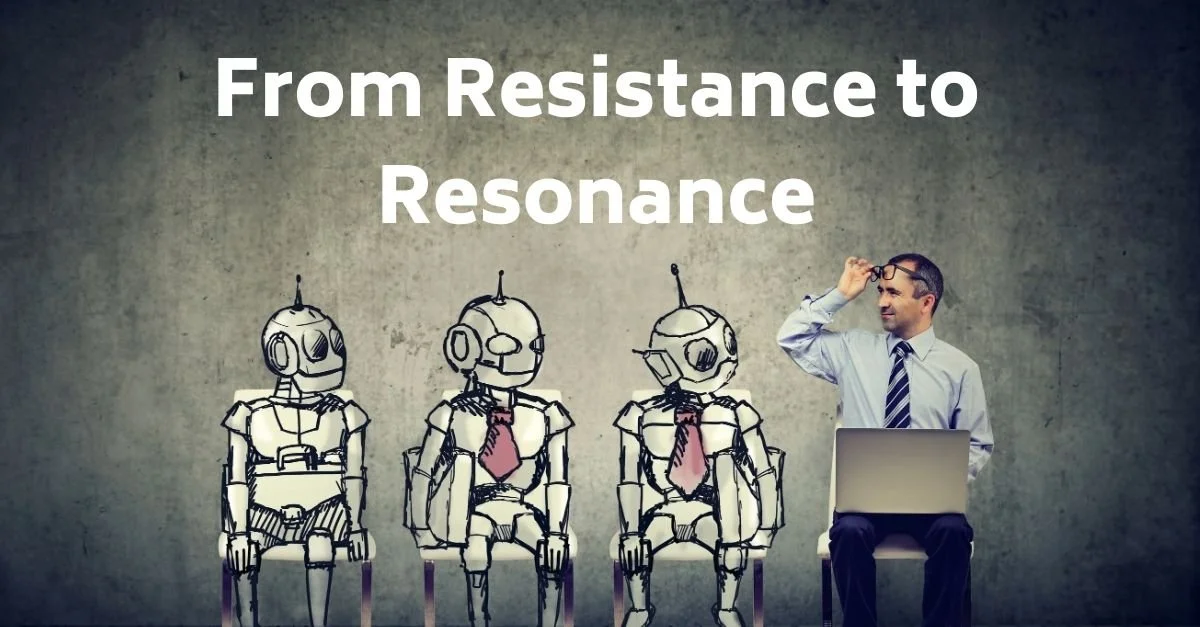
From Resistance to Resonance
Executive Summary
Most AI transformations do not fail because the technology is weak.
They fail because organizations cannot metabolize the consequences – which is why more than two thirds of major change efforts stall on the human side, not the technical one.
The better an AI system works, the more clearly people see what will change:
roles, routines, expertise and status built over decades.
That is why the real bottleneck of AI transformation is not compute power.It is leadership.
The Resistance Paradox
The better your AI solution works, the stronger the resistance it creates.
Because the better it works, the more brutally clear it becomes what will actually change.
Roles built over twenty years.
Expertise people are proud of.
Routines that structured professional identity.
Imagine a Head of Quality in a mid-sized machinery company who spent two decades learning to “see” defects.
Now a model flags patterns in seconds that took years to internalize. Rationally, this is progress.
Emotionally, it feels like erasure.
People are not resisting AI as such.
They are resisting loss:
Loss of relevance
Loss of routine
Loss of identity
Now we need leaders
Leaders are especially needed now – not as number‑crunchers, not as business‑school caricatures, but as human beings who can hold tension, hold energy and hold a clear direction.
People who can sit in uncertainty without immediately reaching for the next framework, who can sense when a team is in freeze or fight, and who can gently bring them back into movement.
Most change initiatives do not fail because the concept is wrong.
They fail because the human side is underestimated.
Strategies are convincing.
Business cases are solid.
But nobody addresses what actually scares people.
Multiple studies on AI and digital transformation show that 70–90% of initiatives fail to deliver their intended value, mostly due to leadership, culture and adoption issues – not model performance.
The real CEO question becomes:
Can my organization stay in a living relationship
with its work while everything is being rewired at AI speed?
Art of dealing with fear
Fear around AI is normal. It touches real things: identity, competence, status, job security, belonging.
In teams it often shows up as:
Open resistance (critique, sarcasm, “We tried this before”),
Slow‑walking and endless meetings,
Over‑compliance (“Of course we do this”) without real engagement,
Quiet withdrawal into day‑to‑day tasks.
As a leader you do not have to remove fear, but you can hold it:
Name it and normalise it (“It makes sense this feels risky”).
Give a clear frame: why this matters, what will change, what will not.
Stay in real contact: ask “What exactly worries you?” and share a bit of your own uncertainty without collapsing your authority.
Then fear becomes less an enemy of transformation and more an honest signal you can move with together.
The 5-Stage Model - From Resistance to Resonance
If you skip one stage, the plan still looks good on slides. But nothing moves in reality.
Stage 1 – Name the Fear
Every AI transformation contains rational business cases and very real fears.
You are not just changing tools. You are changing who decides, whose expertise counts and w whose job gets harder before it gets easier.
The typical fears are predictable:
changing job profiles
loss of status
dissolving routines
shifting power
If leaders pretend these fears do not exist, they do not disappear.
They go underground and become professional resistance – perfectly polite, impeccably reasoned, and lethal to momentum.
A simple exercise:
Run a 60‑minute session with your leadership team and ask one question:
“What are we actually afraid of in this AI transformation?”
Named fear can be addressed. Unnamed fear becomes sabotage.
Stage 2 – Build the Coalition
Not a committee. A mission.
Most AI initiatives die in “project mode”: too many people in the room, nobody truly accountable.
Four people are enough:
The Visionary – sets direction, removes blockers, takes the political risk.
The Operator – knows where processes really break, not just how they are documented.
The Skeptic – your most critical voice turned into co‑owner, not sidelined into opposition.
The Communicator – translates AI into human language for every layer of the organization.
The skeptic is the most important choice.
When the person most likely to resist becomes visibly responsible for success, every other skeptic pays attention.
One converted skeptic is worth more than ten enthusiasts.
Stage 3 – Translate the Vision
“AI” is not one story. It is four different stories told into the same room.
Engineers hear automation.
CFOs hear cost and risk.
Middle managers hear loss of control.
Boards hear competitive advantage.
If you speak in one language only – usually the board language – everyone else will nod and quietly reinterpret the message in their own terms.
Leadership means translating the same transformation into different languages without changing its substance.
Stage 4 – Generate Wins, Amplify Them
PowerPoint can carry an AI story for about three months. After that, only results count.
Nothing kills an AI transformation faster than six months of
“we are still building”.
Nothing accelerates it faster than one visible, incontestable win.
For example:
defect rates reduced on a critical line
planning cycles shortened from weeks to days
service issues detected before the customer notices
The win does not need to be huge.
It needs to be real, measurable and clearly linked to AI‑enabled ways of working.
Stage 5 – Anchor It in Culture
In the end, technology does not decide. The nervous system of the organization does.
Culture is what people feel in their bodies when they come to work.
Is work a place of creativity – or of cortisol?
Is failure treated as information – or as threat?
Can people speak honestly upwards – or do they learn to perform and conform?
Resonance in this context means that people feel connected – to their work, their tools and the direction of the company – even as AI rewires how value is created.
Where This Work Happens
These are exactly the questions we work on with a small group of industrial owners and CEOs during the Art of Life Executive Learning Journey in Silicon Valley.
In a €200m industrial company, friction in AI transformation can quietly burn €1–2m of EBIT per year through downtime, scrap, missed insights and slow decisions – without ever showing up as a separate line item.
So the real starting question is not:
“Which AI tool should we buy?”It is:
“If AI is already changing our cost structure and our decisions, do we want to lead that change – or react to it?”
And more concretely:
“Where are we already losing money because our organization cannot yet think and move at AI speed?”
Silicon Valley Executive Learning Journey - October 19-23, 2026 Limited to 7. Confidential.
June 8–12, 2026, Limited to 7 participants.
Author: Werner Sattlegger Founder, Art of Life
office@the-art-of-life.at | www.the-art-of-life.at
Vienna · Klagenfurt · San Francisco
Further Reading & Sources
McKinsey – “Reconfiguring work: Change management in the age of gen AI” (2025)
Explains how gen‑AI programs stall when treated as tool rollouts instead of leadership and operating‑model shifts, and outlines what successful sponsors do differently.
Link: https://www.mckinsey.com/capabilities/quantumblack/our-insights/reconfiguring-work-change-management-in-the-age-of-gen-aiProsci – “Why AI Transformation Fails” (2026)
Summarizes common failure patterns in AI‑driven change and quantifies how poor sponsorship, low engagement and inadequate change management undermine AI initiatives.
Link: https://www.prosci.com/blog/why-ai-transformation-failsAnu D’Souza – “Why 95% of AI Transformations Are Failing—And Why Leadership Starts With You” (LinkedIn, 2025)
Argues that most AI programs fail due to unclear ownership, fear and lack of genuine leadership commitment, not because the models underperform.
Link: https://www.linkedin.com/pulse/why-95-ai-transformations-failingand-leadership-starts-anu-d-souza-lccpc
Leadership and the organizational “nervous system” in an AI world
McKinsey – “Building leaders in the age of AI” (2026)
Describes how AI changes what leadership looks like, emphasizing emotional regulation, psychological safety and experimentation over command‑and‑control.
Link: https://www.mckinsey.com/capabilities/strategy-and-corporate-finance/our-insights/building-leaders-in-the-age-of-aiProsci – “8 Ways AI-Driven Change Is Different (And What Change Leaders Must Do)” (2026)
Highlights how AI‑driven change intensifies uncertainty and why leaders must focus on trust, transparency and adoption metrics.
Link: https://www.prosci.com/blog/8-ways-ai-driven-change-is-different
On resistance, resonance and acceleration
Hartmut Rosa – “Alienation and Acceleration: Towards a Critical Theory of Late-Modern Temporality” (2010)
Explores how accelerating change creates alienation and introduces resonance as a way to restore a living relationship to work, tools and others.
Link: https://www.goodreads.com/book/show/9539608-alienation-and-acceleration“Exploring Resonance & Acceleration with Hartmut Rosa” (video)
A conversational introduction to Rosa’s ideas on acceleration, alienation and resonance that are highly relevant for thinking about AI‑driven transformation.
Link: https://www.youtube.com/watch?v=HuXsoK7y1FQ
The leadership gap in AI adoption
McKinsey – “AI in the workplace: A report for 2025”
Shows that almost all organizations invest in AI, but only a tiny fraction see themselves as truly AI‑ready, with leadership and culture as the main bottlenecks.
Link: https://www.mckinsey.com/capabilities/tech-and-ai/our-insights/superagency-in-the-workplace-empowering-people-to-unlock-ais-full-potential“Why Your AI Transformation Will Fail If You Leave It to IT” (various executive pieces)
Make the case that AI must be owned at the business and CEO level, not as an IT side project, and outline concrete roles for top leadership.
Example: https://www.linkedin.com/pulse/why-your-ai-transformation-fail-you-leave-peter-kerr-rdcme

Autor: Werner Sattlegger
Founder & CEO Art of Life
Expert in digital transformation processes, helping European mid-sized family and industrial companies move from the comfort zone into the learning zone. He loves connecting people and organizations, thrives in uncertainty and the unknown, and is driven by a deep passion for shaping and enabling development.